New U? Unions have an Image Problem
Article by
David BarringerMay 16, 2006.
Righteous whiners. Desperate losers. Defensive liberals. Those who
call for social justice are often made to sound like shrill
complainers. Consider unions. Say, “union,” and a young person
today imagines a white, middle-aged, pot-bellied factory worker, a
stereotype representing a blue-collar middle class, diminishing in
size and strength every year. The future of unions depends on the
service industry, on, essentially, the likes of these young people
who regard unions as dead. Unions have a serious graphic image
problem.
Unions seek social justice for the worker, and social justice
depends on compassion for those left out. The movements for the
civil rights of women and minorities rallied supporters by
asserting the value of compassion. Today's social causes have to
persuade supporters to be compassionate, but they also have to
recruit members by getting people to admit they need help. To seek
strength in your union, you have to admit weakness in yourself.
People don't like doing this. Maybe people don't admit to being in
the working class because they hope to escape it.
How do unions present themselves today?
COLOR. Blue rules. The colors of the American flag are as
omnipresent as they are in political-campaign literature, but a
quick survey of the printed materials and websites of several
unions (AFL-CIO, UAW, Teamsters, National Writers Union, Graphic
Artists Guild, even the ACLU for good measure) reveals that blue is
the color of choice. Are unions consciously using blue to represent
democratic “blue states?” It's possible, but it's more likely that
the blue mood predates the red/blue divide. Sticking with red,
white and blue, unions reject too much red (evocative of Communism)
and up the blue (more conservative, literally). A sample of website
headers can be seen in Fig. 1.
TYPE. Sans serif, brothers and sisters, all the way.
Futura is no-nonsense, modernist, industrial. Helvetica is a
workhorse. Universal ain't no Ivy League sissy. Unions take pride
in their gritty urban origins. Nostalgia for their hard-knock
tradition is sustained in simple, clean, thick, stand-up type. A
sample of magazine and newsletter covers can be seen in Fig. 2.
These particular periodicals are distributed internally to members.
You can download PDFs of many of these online (see links to the
right).
DESIGN. Union design, thy name is Grid. Concerned not with
looking good but with working straight, union design relies on
grids, columns, boxes of blue and blocks of quotes, anything to
fill up the space. Union magazines are like newsletters. Their
straightforward, dull aspect promises solid information, not
corporate candy and PR puff pieces. Anything artsy is suspect. If
it looks too good, it's either lying, selling something or trying
to make people feel stupid. The layouts in Fig. 3 typify the look
of most union periodicals.
PHOTOGRAPHY. Respect the worker. The purpose of union
photography is to feature people, not products. Union photography
promotes solidarity among all workers by depicting portraits of
diversity: black, white, Hispanic, old, young, male, female, etc.
Diverse people cut out and arranged against backdrops of patriotic
colors attempt to sustain America's vision of itself as a melting
pot of all peoples. A recent cover of
Solidarity, a UAW
magazine (Fig. 4), features one white male, one black male, one
white female, one black female.
Unions have so much going for them. They have people, stories, a
cause. They're underdogs battling bad guys in the Bush
Administration. Their leaders are democratically elected
representatives accountable to their constituents. They have
American authenticity in a way that corporate marketing departments
can never concoct.
So why does the union look feel outdated, untouched by popular
culture? Its stodgy and desperately sincere look may reinforce the
distance young people see between life on an assembly line and life
on aisle three. Compare unions with companies, and unions appear to
lack a sophisticated up-to-date visual language capable of rising
to the rhetorical challenge. Many union leaders admit their message
fails to register with younger generations, but they also admit
they don't know why. The Service Employees International Union
(SEIU) uses purple and gold to achieve a younger, more approachable
look (Fig. 5), but it relies on the same tropes of photography and
design as the industrial unions. Unions date themselves by walking
and talking like grumpy grandparents. Young people think, “Yes, but
what does this have to do with me?”
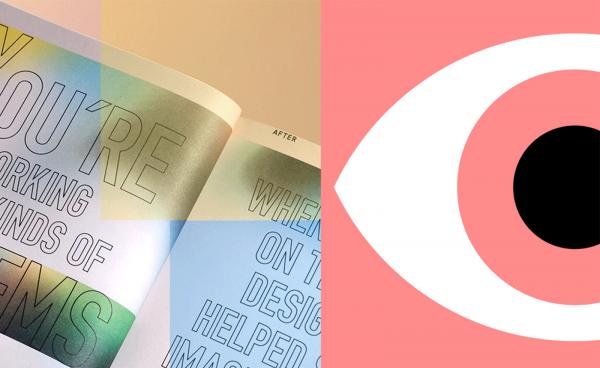
I've done writing and design work for unions for nine years, and
while I've had a good view from the sidelines, I don't have a grand
remedy. (On that note, let me make my own work available for
potshots; Fig. 6 includes three magazine spreads done for UAW-Ford,
a nonprofit joint program that distributes a periodical
internally.) The fiercely adversarial relationship between unions
and companies has long since been replaced by a joining of
interests (profit-sharing, for one, and job security tied to
keeping the company competitive). In the old days, hard-hitting
cartoons and caricatures were as common as actual hard hitting.
Today, many unions are in a bind, and it shows in their restraint
(graphically and thematically).
Unions could decide to do what companies do, that is, take more
design cues from popular magazines, movies and television programs
in an attempt to reach the younger Wal-Mart/Target/Starbucks
demographic. As for content, the examples of the satirical
newspaper,
The Onion, the satirical cable programs
The
Daily Show with Jon Stewart and
The Colbert Report,
and even viral videos provide lessons on how to connect with your
audience by making fun of the enemies of common sense and the
Constitution. Jon Stewart presumes you share his point of view and
leaps to expose the witlessness of those in power. Stephen Colbert
satirizes neoconservative attitudes by pushing them to extremes.
They do what Democrats and unionists and Michael Moore have not
been able to do: make Republicans and corporate apologists look
like old pot-bellied, humorless has-beens—that is, like
parents.
If you want people to join your team, you can make it uncool to be
on the other team. You can turn economic weakness into cultural
strength. You can turn compassion into outrage, and outrage into
laughter. The question remains whether unions can turn individual
laughter into collective action. Do they need a hip new magazine
called, simply,
U? Ads on TV, radio, and billboards that
make joining a union seem as cool as playing in a punk band and as
adventurous as joining the Marines? New logos, jackets, slogans—in
short, a complete overhaul? They could make the other team look
uncool, but they still have to make their team the one to join.