In-house at Whole Foods Market: An Interview with Kelly Stevens

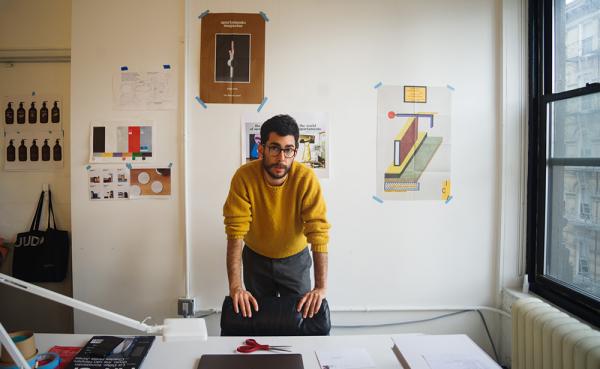
Kelly Stevens is Whole Foods Market’s Southwest regional art director.

The interior of the recently opened Whole Foods Market Arbor Trails store in South Austin.

Team T-shirt design for the Bee Cave store in West Austin.

New juice labels for the juices made in our produce department. We used to have plain black-and-white labels, and we wanted to let our guests know we squeeze this juice right there in the store, every day. We sought to reference vintage fruit crate labels to add some color to the bottles.

This shows the end result of our work with the seafood team to tell the Seafood Sustainability program story. We wanted a simple story to come across first, but also offer the deeper story for anyone who really wants to know about the seafood they are buying.

Getting interactive with our messaging: moving “gobos” on the floor of our Park Lane, Dallas store.

The new food truck in Austin, Texas.

Catering menu folder cover, which Stevens styled and shot.

An example of how we tell the local product story in our stores and bring our farmers’ stories to our guests. Stevens shot the photo of Mr. Martinez and his grandson on their farm a few summers ago. “It was 107 degrees that day, but it was one of my favorite days out in the field,” explains Stevens. “He taught me how a farmer gauges how hot a jalapeno will be.”

A bag designed for the opening of our three new Austin-area stores. We were excited to be opening new stores in our hometown—we have so much pride about being “Homegrown in Austin.”
Andy Kurtts, design manager at The Fresh Market, sits down
with Kelly Stevens, art director for the Southwest region of Whole Foods Market, to find out what it’s like to work in-house for the natural
foods supermarket chain.
Andy Kurtts: So perhaps you could start us off by describing
your professional background. How did you get into the in-house world of the
food industry?
Kelly Stevens: After graduating
from college, I first took a job with an advertising agency and was laid off after only a year and a half there. But I had this project I’d started working on in
school, where I designed a line of pajamas. And I thought, “Call me crazy, but
I think I want to go make those pajamas now.” I took out a loan from my
parents and worked at home for a year on the pajama line. But just as the
product was about to go to market, the clothing industry started to
fall apart.
At that very moment, a
friend of mine who had also been laid off called me and said, “Hey, I just
turned down a job. But Kelly, this job is for you. This team is for you. These
people are for you. I’ve already given them your name. I’m not asking your
permission.” The company was Whole Foods Market. This past January was my tenth
anniversary there.
What’s the most satisfying part of working in-house at the company?
I’m a total people person. When
I see a happy person, that’s what’s most emotionally fulfilling for me. It’s
when a customer stops me and says, “We’ve been waiting for you to open. This
store is beautiful and I found this product that I’m in love with. I’m really
excited that you’re here.” That is truly rewarding.
On the design front, I enjoy taking
the idea of wholesome foods and turning it into packaging, into interiors. I
get to tell a story. I work closely with the team that oversees the interior designs
of our stores. I also do a lot of the writing for our marketing materials and I
shoot a lot of our photos. I enjoy sitting down with our bakery coordinator or
our seafood coordinator and asking, “What are you trying to do? What do we want
people to feel? What do people have to know about this product?” Because we’re in
a story-rich environment, it’s sometimes hard to develop succinct messages. So
I sit down with my colleagues to craft language and photos that
succinctly tell someone cruising past, with a shopping cart, why a particular Whole
Foods Market product is the right product to buy.
And what sort of stories do you tell through design?
There’s a gentleman, Jeremiah
Cunningham, who I’m very fond of. He’s about 30 minutes outside of Austin, and he
started producing pasture-raised eggs. He was the only local farmer grinding his own organic feed and grazing his chickens in a pasture, and we were going to carry his eggs. We first drove out to his place and had a nice,
long chat with him. And he told us, “I just know that these are going to be the
world’s best eggs.”
So I said, “Jerry, I really
want to call them Jeremiah Cunningham’s World’s Best Eggs, because you’re a
real person.” He’ll tell any customer to come out to the farm and meet his
chickens, and I couldn’t disconnect his product from his personality. So he and
I worked together to develop his brand. To be able to take that story, from “this
is what someone is making” to “this is how it gets to our stores” to “this is
why we think it’s best,” I find that very fulfilling.
Given Whole Foods Market’s regional focus, where do you get your
inspiration?
I personally do a lot of our
retail design work. Often, I’m art directing and sometimes even designing by
hand, depending on the store interiors. So if we’re looking at a new market, we
get to know the community and the people; we eat in their restaurants and we
shop in their shops. We really just go into a neighborhood and kick the tires
on that community, so to speak, to try and figure out their needs and aspirations.
Getting out there and gaining a sense of what’s happening in other places,
having that full sensory experience, it helps me design. It’s probably more inspiring
than anything else.
How much time do you and your team spend in your own stores
around employees, customers and vendors? How do these interactions affect your
design process?
Well, there’s the design side
of things and then there’s the fundamental implementation, at the store level,
with graphic artists. We have two to four folks who are responsible for all the
gorgeous chalkboards and the price item signs that you see in our store. Graphic
artists understand the operational side: how design collides with the customer
experience, as well as issues of implementation. The designers will call me and
say, “We’re not going to be able to keep these signs up because the carts run
them over. We need to come up with another idea, because the way you’re placing
the signs, it literally isn’t going to hold up.”
Getting out into the stores
themselves is important, so two folks on my team are on the road full time.
They hop from store to store, looking at what’s going on and giving us constant
feedback. I really depend on them. Our regions function quite autonomously, so maybe
there’s some wicked stuff happening in Northern California that I have to go
see for myself. There’s also a lot of photo exchange across the company, a lot
of, “Hey, I heard you had a great program in your meat department. Can you send
me pictures?” Or we’ll run into somebody and they’ll say, “Your bakery signs
better than ours. Can you send them to us?” It’s incubation not in silos but in
different Petri dishes. Part of my job is to make sure these innovations hop from
Petri dish to Petri dish, across the whole company.
How does this collaboration play out
at a higher level, beyond the individual stores?
Every Whole Foods Market has a
store team leader, who is the manager. All of our folks report in part to our
team and in part to the store team leader. Then there’s the regional level and
what we call our global team, since we’re now an international company. In many
ways, we are quite independent; I don’t report to anyone at the global office,
but we have this lovely relationship with them. If they see a global need for a
program, sometimes they will take on that program for us, which takes work off
of our plate. They function almost like another brain feeding us ideas, so we
rarely feel like we’re being told what to do from on high.
I think everybody at the company acknowledges that the best innovations come from the store level, meaning
we get a lot of bottom-up rather than top-down innovation. I would say that 90
percent of the time, I don’t feel like I’m being told I have to do something,
or that I’m simply executing programs that come to us from a faceless office. Every
day I have a chance to participate in collaborative problem solving, which is part
of the reason I’ve stayed with the company for so long.
How do you prioritize your projects? Do you have a tiered system?
Or is it first come, first serve?
Our team has grown quite a bit
over the last three to four years. Back in the day, I used to be the only
designer. Our marketing director did a lot of the project management; I did all
the production management. I basically took the information, designed it, sent
it to the printer and got it to the stores. Our team has since quadrupled in
size, and we’re also supporting a growing number of stores. I think we’re at a sort
of crossroads. Information lives in so many pockets, and we’re going to have to
find new ways to prioritize our work.
Of course, there’s always the
issue of retail, where innovation happens on the turn of a dime. We’ll think
that we know what we’re doing for any given week, but then something big comes
along and we have to drop everything, switch gears and work on it. Then we go
back to our bigger, longer-term projects. So we’re constantly striking a
balance between doing a little bit of planning and leaving a little bit of wiggle
room for things that appear out of the blue, like comets.
Does your team do a lot of prototyping—just printing something
off and taking it to the store itself to see how it works?
In some cases, yes. Our stores
are all over the map in terms of size, age, execution and style. A store we designed
in the 1980s feels different than a store we designed in 2005. We aim to keep
them more or less in step with each other, but we might still design something
for a case in one of our stores that simply won’t work well in the others. Overall,
we’d really like to do more in-store prototyping. Occasionally we’ll send
something to one store and say, “Hey, can you guys put this up, shoot a photo and
tell us what you think?” And sometimes they’ll write back and say, “You know,
it looks okay in the photo, but it’s not really working for X reason.”
I think our new stores are
really the incubators, especially when it comes to permanent items, such as signage.
While we make smaller leaps when we do a remodel or embark on a new program, I
would definitely say that the giant leaps happen when we open a new
store.
Does your team do brand design packaging?
Yes, we design a lot of the regional packaging. So if we’re talking about
the box that holds pies in my stores in the Southwest region, then yes, I
design those boxes. If my bakery coordinator decides that they want to create a
new candy and we need packaging for that candy, then yes, we do that as well.
All the stickers that we use to label our products, my team does a lot of
that work. If you pick up a
salad in one of my stores, my team probably designed the sticker.
When you’re creating these items, is it challenging to work with
the Whole Foods Market brand while also trying to make the design mesh
regionally?
That is always a really interesting
challenge, because we do have brand standards. I think that as a designer, you find
the places where you can color in the lines, and then you find the places where
you can innovate. That’s something really awesome about the Whole Foods Market
brand; it’s so elastic that you can sometimes stretch the boundaries a bit. Our
measure here is, “Does it feel like us? I know this isn’t our standard
typeface, but I think it feels like us.” You can go too far in the other
direction, however, when you pick a new typeface just for the sake of picking a
new typeface, or you do something off the wall and it doesn’t stick. I like to
think that we’re not so much brand warriors as we are brand shepherds.
Yes, or brand stewards. That’s what we call ourselves at
The Fresh Market.
Absolutely. As shepherds, we have
to herd the entire flock. But sometimes a bakery box escapes! In fact, we just
had a big discussion about redesigning all of our bakery packaging. We sat down
with our bakery coordinator and she outlined her goals: where she wanted to be
and what she wanted her department to feel like. Something that felt more
earthly. Something that went back to our roots. Something that felt like an
old-school bakery.
So I sat down with the designs we’d
been working with, and I pushed them to the left and then to the right. We
executed a bunch of mockups and put them all on the table. Then, when nobody
was looking, I went into my corner and did something completely different—something
that I felt was truer to the aesthetic direction we wanted to go.
I sat down with the team and
said, “Here’s what would happen if we did what we thought we were supposed to
do, if we follow the flock.” And then I moved all that stuff over to the side, put
a couple of the new boxes on the table and said, “This is what I would do if we
were to start from scratch.” The new designs still fit within our brand, of
course, but they gave the vision more tooth. My project manager looked at me
and said, “I just think it’s right.”
What are some of the unique challenges you face as an
in-house designer?
I think you have to work extra
hard to expose yourself to new ideas. In an agency, where you have multiple
clients, you have multiple points of feedback coming in and you’re constantly forced
to consider radically different perspectives. But when it’s food and retail, food
and retail, food and retail, you have to take extra steps to make sure you’re
exposing yourself to outside stuff. In-house, it’s easy to get tunnel vision.
Do you have any advice for in-house designers who find
themselves struggling to reconcile client or corporate demands with good design?
I think the most important
thing you can do is build strong relationships with the people you’re working
with. For instance, I wouldn’t dare tell our meat team what’s the best cut of
meat. That’s their job. And once I’ve developed a good rapport with them, they won’t
dare tell me what makes good design. We simply respect each other’s worlds and we
respect the knowledge, passion and experience each side brings to the table.
And then we work together to find some place in the middle. That process starts
on a personal level, with being able to talk to my colleagues as individuals,
not as a department or an office.
A
great example of this is our new Seafood Sustainability program. Whole Foods Market no
longer carries seafood that is rated “red,” which includes species that are threatened
by overfishing or harmful fishing methods. It’s a hard program to
talk about, and it’s difficult to effectively explain the rating system to
customers. The seafood team, of course, knows all about the fish and why a
specific type of fish is no longer sold. But they weren’t quite sure how to
communicate that information to the customer. So they came to us and said, “Hey,
we’ve got to figure out how to tell our store’s guests this really complicated
story.” Finding a common message isn’t always easy or comfortable.
But I think once the seafood team understood that we had their best interests
at heart, and the best interests of the customer, they entrusted us with the
design decisions. In the end, they don’t care what color or typeface it is—they simply trust
that I’m using their knowledge and their passion for the product to communicate
the issues visually.
You’ve been in-house at Whole Foods Market for more than a
decade. What is one of the most important takeaways you’ve gained through
that experience?
Given all that I’ve learned during
my time here, if I had my pajama line to do over, for instance, I would be
obsessive about organic cotton and the inks that I would be using. It’s funny, but when
I look back on it all now, my experience here has taught me how I should have
produced a product differently. I realize how important it is, for the
environment and for our global community, to develop products in ways that don’t
trash everything we hold dear.
About the Author:
Andy Kurtts is an illustrator and designer at the corporate office of The Fresh Market, a specialty grocery store. He studied illustration, design and printmaking at Ringling College of Art and Design, where he graduated in 2006. His responsibilities
at The Fresh Market include working as part of the in-house design team on in-store signage, promotional pieces, catalogs, and private brand packaging design. Outside of the office, he enjoys printmaking and creating work for himself.