How Bob Calvano Is Building a Strategic In-house Team (Part Two)
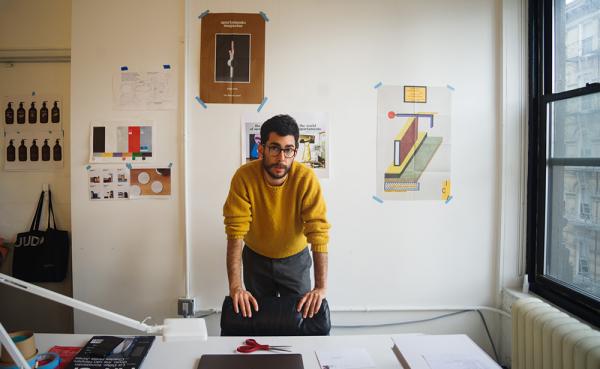
As part of restructuring the in-house design team at Merck, Bob Calvano has introduced a collaboration wall, where designers can display their works in progress for impromptu conversations and critiques. (Image courtesy of Bob Calvano)
Bob
Calvano heads up the Media Services group, a 50+ multidisciplinary in-house
creative team at Merck, one of
the leading pharmaceutical companies operating in today’s global marketplace. In
this edited three-part conversation, he outlines the strategies and tactics he
and his group are employing to raise their stature and increase their impact—and offers valuable insights to help you do the same.
Part
one of the conversation focused on marketing and account management. In
this segment, Bob discusses the structural changes he made to his department,
how he convinced management and his team to get behind those changes, and the
benefits he’s hoping will result from the reorg.
What are you doing
internally with your team—the structure, the people you have, the way they’re
working together—in order to make your group more strategic?
I needed to simplify the structure, and I think we’ve done that by taking out some of the layers and distinctions of visual communications, research communications, and creative communications, so that the perception and line of communication internally is more straightforward and not siloed.
In other words,
they’re now broken down more by function than by what internal businesses the
staff were servicing?
Yes. So the legacy of how this team came together…at one point it was five or six groups that were kind of mashed into one, and they continued operating the way they had always operated. Now internally I’m getting the team to operate as one team, think as one team, and to have one budget versus multiple budgets. I’m to simplify the organization as much as we can for clients and for ourselves by consolidating the groups by the services they can offer to our clients.
What is it that would
happen on the client side with the more complex modeling that you had in place?
Well, there was a complexity in understanding who should
they go to. Say they went to media services. Well, who was media services? It was really no one until they got into one of
the silos like research communications or visual communications. And then in
visual communications, well what was that
made up of? It was photography and webcasting and video production. And then,
who should they talk to there?
A client really doesn’t know who to go to because there are
so many different functions and skill sets and lines of business. So from a
client perspective, simplifying the way the organization is structured helps
them understand where to go, and by putting account management in place [read
more about that in part one of this conversation], we’re really going to be
able to hold their hands a bit more and have a single point of contact, and
they shouldn’t worry about well, do I need to talk to the webcast guy or the
video production guy? They should just know what their needs are, and we should
have account managers on the front line understanding those needs, bringing
that business into the organization and having it be really transparent for
folks. They shouldn’t get caught up in the layers or complexity of the
organization or how we’re structured.
So what’s the benefit
for the people on the inside?
Well, Merck in general is siloed by the different divisions
they have, and then it’s siloed by the different organizations within those
divisions. Our setup was no different than the rest of the company’s, so we had
these silos too.
I think what this new structure will do is open up
collaboration across all the different areas where we provide creative
services. So photography and video production and print design and interactive
design will all feel a bit more like one organization versus multidisciplinary
teams working for different corporate business areas. It’ll help everybody
collaborate or see things a little more holistically. There is an “us and them”
vibe going on right now, and I want to eliminate that internally and have the
group be one very cohesive, collaborative organization.
You’re reorganizing
who reports to whom and what the different teams are, so I have to ask, did you
get resistance to that and how did you address that resistance?
So the first part of the question is, has there been any
resistance? And I think yes is the simple answer. But I’m getting the
buy-in.
Merck is a place that loves to talk about change and then
when you actually go to implement change, it’s a culture that’s not very
receptive. People have been here a long time, they’re very set in their ways,
it’s a wonderful place to work and trying to change all that is stressful for
folks. So I’m seeing that; not so much that there’s resistance, but that
there’s anxiety or fear about change, and it’s upsetting what people have known
for the past twenty-five years.
The way that I got buy-in from a structural perspective was
going to my boss and presenting her with what I thought had to be done and the
foundational elements we needed to put into place if we were to scale globally,
which I know the company wants to do. Part of that requirement was having a
flexible workforce, partnering with a staffing agency to put that flexible
workforce in place that allows us to grow where we need to grow.
So once I presented the structure to my boss and she said
OK, I took my strategy up another level to the vice president. In that
presentation, I showed the vice president, from a vertical perspective, all the
different areas that we were addressing: how we were going to address customers
with account management, how we were going to address the business needs around
the scientific side of this company, and how we would address issues from a
design studio and media perspective.
Then I also showed the horizontals in this model, what the
Merck full-timers would offer on a strategic level. They were going to be the
leadership team to help drive the studio where it needed to go, shaping our
future and current business, helping to direct the growth and really owning the
quality of the work of the group going forward.
I was pitching a whole business model, and at the VP level it was very well received.
What effect did the
restructure have on the staff side, the studio side? What was happening there
that you had to address?
On the staff side, what I did to make sure I was going to
get all the support I needed, to get the buy-in, was to bring in my managers as
early on as I could and get them involved in the decision-making process with
an understanding of the “why.” Why were we doing this? What did we need to put
in place and why? What were our goals? What were our challenges going to be?
Once the mangers were on board, they could disseminate the strategy down to
those reporting to them and from there down to the individual contributor
level. I needed my managers to support this because if any one of them didn’t
believe in it or support it, we’d be, I’d be, doomed.
What are you doing to
create this more collaborative environment beyond just the reorg, the
structural changes within the group?
Yeah, so there’s the reorg on paper, right? To
break those silos down on paper is one thing, but I’ve actually gone ahead and
said, OK, we need to change the way we work physically, our spaces. Merck is
your typical corporate cube environment, and it doesn’t promote collaboration
in any way shape or form, so we’ve taken all the cubes out of the space, we’ve
knocked down walls, we’ve created an open space. We’ve changed everybody’s
desks, the way that their monitors are mounted and their work space
so that it’s completely open. You’ll be able to see across the entire area
versus that land of cubes.
I’ve put in a wall that is a collaboration wall where
designers can go and hang their work up and have impromptu sort of
collaborative conversations around the state of a poster or project or any
design work, to get people openly critiquing each other’s work in a space where
you can actually see that the conversation is happening.
We’ve also created collaborative work areas within the
space, so what was an office is now a room that’s a collaborative workspace
where the entire wall is a white board to get people into rooms
having conversations, very authentic creative conversations, and to get
everybody thinking out loud so that people can see these conversations and join
in the conversations. It’s about as big a change as you can do to people here
at Merck—take away their cubes, their own little private spaces.
I’m going to have to lead by example. I’ve started
doing that by having conversations in front of this wall, this design wall, to
get people out there hanging their work up, sort of exposing themselves and
getting adjusted to and comfortable with what criticism sounds like. It’s a
really tough environment at times, but I want it to be very constructive, to be
supportive of people’s work but also try to get the level of the work up a bit
higher. The only way to do that is to have some conversations around hey,
what’s going on? What’s working, what’s not working? How do we make that better?
About the Author:
Andy Epstein started his career as a freelance designer and illustrator with clients as varied as Bacardi, Canon, Bantam Books and Merck. Jumping into the world of in-house in 1992, Andy created and grew in-house design teams for Commonwealth Toy and Gund.
He later restructured and expanded the hundred-person creative team at Bristol-Myers-Squibb and consulted at Johnson & Johnson. After a three year stint at Designer Greetings leading an in-house design team responsible for the company’s product lines and Point
Of Sales materials, Andy moved back into pharma heading up a 65+ managed services team at Merck.
Andy has written and spoken extensively on in-house issues and published “The Corporate Creative”, a book on in-house design, in partnership with F&W Publications in the spring of 2010. He is a co-founder of InSource, an association dedicated to providing
support to in-house designers and design team managers. Most recently he was head of INitiative, the AIGA program dedicated to in-house outreach and support where he expanded on his efforts to empower in-house teams and raise their stature in the design and
business communities.