A Shrine to Storytelling
Article by
Adrian ShaughnessyDecember 10, 2004.
A magazine published by the great film director Francis Ford
Coppola might be expected not to conform to formulaic notions of
magazine production.
Zoetrope: All-story, the
quarterly magazine Coppola founded in 1997, is not a conventional
magazine. It features eight to ten short stories per issue, carries
barely any advertising, and has a different 'guest designer' for
each issue. Coppola describes his magazine as “supporting the
brightest young voices in fiction”-itself a revolutionary idea in
this era of celebrity trivia and sound bite journalism.
Coppola's magazine is a shrine to storytelling. Surprisingly, there
are no screenplays or movie treatments, just 100 or so pages of
prose. As he explains in a “letter to the reader”, published on the
magazine's website: “I have never met a person in the film business
who enjoys reading a screenplay. It is usually a dreaded obligation
that one does in sections of twenty or thirty pages, ending up with
a skim-through of the last thirty pages.” Coppola contrasts the
dread of the screenplay with the charm (and brevity) of the short
story and notes that many great films have been made from short
stories (
Psycho,
Rear Window,
High
Noon). He continues: “There was a storytelling tradition in
force in the twenties and thirties that, among other things,
inspired and taught the screenwriters who became responsible for
the fine movie writing of the forties and fifties. Today, the
heroes are the film directors, and many aspiring writers think that
they must write a screenplay or movie treatment rather than focus
on the story itself. If
Zoetrope publishes a single short
story that evolves into a memorable film then, in my mind, it would
more than justify our efforts to produce this magazine.”
Most commercial magazine proprietors would consider producing a
magazine that only featured short stories to be the publishing
equivalent of going for a swim in a lead bathing suit. Nor is
Coppola's intriguing concept of a different guest designer for each
issue likely to win him approval from a publishing industry that
views magazines as brands rather than cultural artefacts. Yet each
quarter, Coppola invites a different artist, designer,
photographer, musician or filmmaker to shape the look of his
publication. Past guest designers include Julian Schnabel, Mary
Ellen Mark, Helmut Newton, David Bowie, Laurie Anderson, Jeff
Koons, Peter Greenaway, Ed Ruscha, Dennis Hopper, David Byrne, Mike
Salisbury and William Eggleston. Maverick director Gus Van Sant is
at work on the next issue (Winter 2004).
“The idea was originally suggested to me by Mike Salisbury,” notes
Coppola, via email. “He was responsible for the design of our old
City Magazine as well as the breakthrough publication in
LA,
West. The notion was that it would refresh the look of
the magazine with each issue, and, given that it was a short story
publication, would give it visual excitement.” Coppola's guests
succeed admirably in imparting layers of “visual excitement” to his
magazine, and without their contributions
Zoetrope:
All-story would have an academic dryness that might make it
difficult to find an audience.
But Coppola's use of the term “designer” is problematical. It's a
semantic usage that won't trouble non-graphic designers, but for
professional designers—and magazine designers in particular—it's a
controversial piece of nomenclature. Few of Coppola's guest
designers can be said to 'design' his magazine in the technical
sense of the word. Most contributors appear to adopt the role of
“guest illustrator” rather than “guest designer.” And, although
each contributor is free to make whatever changes to the magazine's
appearance that they consider necessary, the periodical's
typography and internal architecture remain fairly constant: a two
column grid, justified text, neo-classical typography and a
sophisticated air of unhurried spaciousness in keeping with a
magazine that is designed to be read rather than scanned at
high-speed by a sensation hungry magazine junkies.
“We urge the guest designers to reinvent the magazine with every
issue,” explains editor Tamara Straus, “but this must be done
within the constraints of our budget. That often means we must use
our very affordable type of paper and cover stock. Also, some guest
designers prefer not to give typographical instructions and rely on
our graphic designers to come up with a page layout that will
respond to their artwork, which the guest designers then refine.
Other guest designers have a hand in every aspect of the design of
the magazine—from choice of font, to use of color, to positioning
of columns of type, etc. There isn't a permanent design and layout
team for the same reason that there isn't an in-house illustrator
or art editor: we want to keep the look of the magazine in constant
innovation.”
In practice, however, alterations to the magazine's layout are
minimal. Small typographic adjustments are made from issue to
issue, but it's doubtful if many of these will be noticed by
non-designers. The Eggleston 'designed' issue is typical. The
standard two column grid, with its book-like simplicity, is
retained. Eggleston's exquisite photographs are used sparingly
throughout; most of them are full page reproductions, but some are
incorporated into the text. None of the images are allowed to
bleed. Each comes with a generous white border which imparts a
distinctive photographic aesthetic and reinforces Eggleston's
famous detachment and his eye for the poetic framing of every day
life.
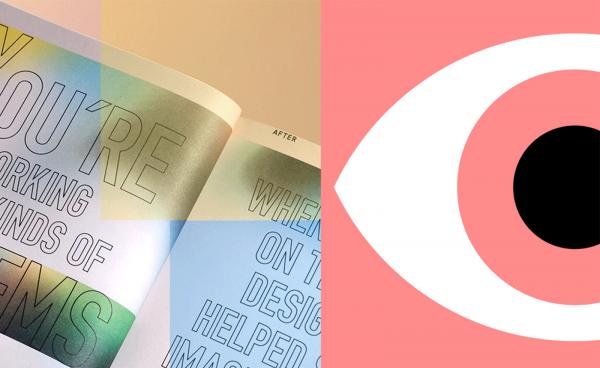
The New York-based graphic designer Eric Baker takes a more
designerly approach (Fig. 1). Baker is one of the few bona fide
graphic designers to occupy the guest designer hot seat. In the
Summer 2003 issue, Baker avoids the over-cooked approach favoured
by contemporary magazine designers and publishers. The entire issue
is based on passport imagery, and the result is a master class in
subtle layout and the judicious handling of graphic ephemera.
Despite Coppola's willingness to let individuals with strong visual
intelligences loose on his magazine, a quiet, understated
consistency runs through all issues. Despite a license to “do what
they want”, none of his guest designers appear interested in
compromising the primacy of the text by snubbing typographic
convention or indulging in experimental layouts that impede the act
of reading. So, while professional designers may quibble with
Coppola's use of the term 'designer', it is hard to quibble with
the results. In truth, his contributors are really 'guest art
directors', but you can understand why Coppola doesn't use the
term: for a non-designer readership, the term guest designer is
more easily grasped.
Coppola's record of choosing brilliant collaborators with which to
make his films forms one of his principal claims to greatness: Dean
Tavoularis (production design), Nino Rota (music), Walter Murch
(sound montage) are inspirational collaborators chosen by Coppola
to enhance the art of film making. Did Coppola regard appointing a
guest designer as similar to the hiring of specialist talent by a
movie director? “I would agree,” says Coppola. “Since our focus is
on the writing, and also given the fact that the designers are
given power over the final form rather than a fee, we are assured
of something unusual. In a sense, the magazine reinvents itself
with each issue.” How does Coppola choose his guest designers?
“Very informally,' he notes. 'We toss around names of people who
have a visual sense—artists, photographers, costume and theatrical
designers—anyone who has a sense of visual imagery. I love the fact
that each time the magazine comes out, it has a different look.”
Zoetrope: All-Story's sales are split equally between
subscription and copies sold at the newsstands. The magazine prints
20-30,000 copies per issue, and the last four issues have sold
out—the most recent issue sold out in two months. As Straus notes:
“Something about our formula is working, although, of course, we
are still a very small circulation magazine.”